

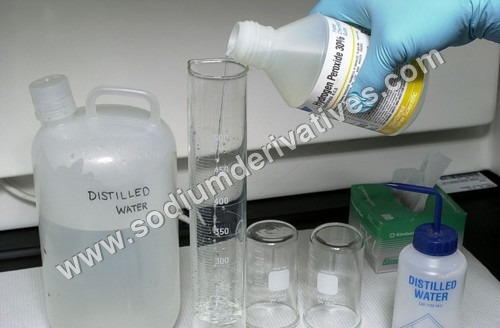

|



Hydrogen Peroxide - 50%
30 INR/Kilograms
Product Details:
- Smell Pungent odor
- Shape Liquid
- Ph Level Acidic
- Application Bleaching, disinfectant, wastewater treatment, chemical synthesis
- Ingredients Hydrogen Peroxide, Water
- Product Type Chemical
- Molecular Weight 34.01 g/mol
- Click to View more
X
Hydrogen Peroxide - 50% Price And Quantity
- 30 INR/Kilograms
- as per requirement , , Kilograms
Hydrogen Peroxide - 50% Product Specifications
- Strong oxidizer, clear colorless liquid, decomposes into water and oxygen
- Chemical
- Industrial Grade
- 50%
- As per industrial requirements and safety handling procedures
- 34.01 g/mol
- Hydrogen Peroxide, Water
- H2O2
- 1.195 Gram per cubic centimeter(g/cm3)
- Acrid
- Bleaching, disinfectant, wastewater treatment, chemical synthesis
- Clear colorless liquid
- Liquid
- Pungent odor
- YES
- 12 months
- Acidic
- Liquid
- 1.398
- 2847
- Miscible with water
Hydrogen Peroxide - 50% Trade Information
- 1000 , , Kilograms Per Week
- 1 Week
Product Description
| No. | Characteristic | Specifications | ||
| 1 | Strength | W/W | 50.0% | Min. |
| 2 | Stability | ** | 0.3 | Max. |
| 3 | Acidity (as H2SO4) | g/100 ml | 0.03 | Max. |
| 4 | Non-Volatile residue | g/100 ml | 0.2 | Max. |
| 5 | Residue on Ignition | g/100 ml | 0.05 | Max. |
| 6 | Iron (as Fe) | ppm | 1.00 | Max. |
| 7 | Copper (as Cu) | ppm | 0.10 | Max. |
| 8 | Arsenic (as As2O3) | ppm | 2.0 | Max. |
| 9 | Lead (as Pb) | ppm | 10.0 | Max. |
FIELD OF APPLICATIONS
As bleaching agent for Pulp, Paper, Textiles, Sugar, Coir Industries
Antiseptic agent in Pharmaceuticals
Sterilizing agent in Aseptic Packing
As raw material for Organic and Inorganic Chemicals, Dyestuffs and Pesticides
Effluent treatment
Propellant for Aircrafts
Oxidising agent for Silver Ornaments
Neutralizing agent in Wine Distillation
Chemical reagent for extraction of different metals: Cobalt, Uranium, Tungsten etc.
As an etching & cleaning agent in Electronic Industry and Process Equipments
PACKING
30 kg, 50 kg HM-HDPE carboys
250 kg HM-HDPE Barrels
Dedicated SS tankers
SAFETY / PRECAUTION
Keep away from heat and water. Avoid inhalation. Use with adequate ventilation.
STORAGE
Store in a cool, dry, well ventilated area, away from heat, moisture, source of ignition and strong alkaline material
Key Industrial Applications
Hydrogen Peroxide - 50% is extensively utilized across various industries. It serves as a powerful bleaching agent in paper and textile sectors, an effective disinfectant in sanitation, and a vital component in wastewater treatment. Additionally, its strong oxidizing property makes it essential for chemical synthesis, contributing to the production of numerous compounds.
Safety and Handling Precautions
Given its poisonous and highly reactive nature, Hydrogen Peroxide - 50% must be handled with care. Safety protocols include using protective gear, storing in cool, well-ventilated areas, and avoiding contact with organic materials or skin. Adherence to proper procedures is critical for safe usage and storage in industrial environments.
FAQs of Hydrogen Peroxide - 50%:
Q: What are the primary uses of Hydrogen Peroxide - 50% in industrial settings?
A: Hydrogen Peroxide - 50% is mainly used for bleaching, disinfection, wastewater treatment, and chemical synthesis in various industries such as textiles, paper, and manufacturing.Q: How should Hydrogen Peroxide - 50% be handled safely during use?
A: It should be managed following strict safety protocols: using protective gear, storing in ventilated areas, avoiding contact with skin, and following industrial usage guidelines due to its strong oxidizing and poisonous properties.Q: When is Hydrogen Peroxide - 50% most beneficial in chemical processes?
A: Hydrogen Peroxide - 50% is especially advantageous when strong oxidation is required, such as in synthesis reactions, bleaching operations, and effective microbial control in disinfection and wastewater treatment.Q: Where is Hydrogen Peroxide - 50% commonly applied?
A: This substance is commonly utilized in factories, processing plants, laboratories, and industrial facilities across sectors like textiles, pulp and paper, and wastewater management.Q: What is the process of decomposition for Hydrogen Peroxide - 50%?
A: Hydrogen Peroxide - 50% decomposes naturally into water and oxygen, particularly when exposed to light, heat, or certain catalysts, making proper storage essential for maintaining product stability.Q: Can Hydrogen Peroxide - 50% be mixed with other substances?
A: Yes, it is miscible with water but should not be mixed with organic materials or strong reducing agents, as dangerous reactions or decomposition may occur.Tell us about your requirement

Price:
Quantity
Select Unit
- 50
- 100
- 200
- 250
- 500
- 1000+
Additional detail
Mobile number
Email

Other Products in 'Chemical Industries Chemicals' category




GST : 24ABICS0518B1ZV- Plot No 627, 100 Shed Area, GIDC.,Vapi - 396195, Gujarat, India
- Phone :08071780558
-
 Send Inquiry
- Key Personnel
- Mr Nitesh Bharti (Proprietor)
- Mobile :08071780558
 |
SUVIDHI INDUSTRIES
All Rights Reserved.(Terms of Use) Developed and Managed by Infocom Network Private Limited. |
